Joe’s Jotter: Shorthand Best Practice for LC Maths 2026 Paper 1 (Friday)
Leaving Cert Paper 1 in Maths is on this Friday 5th June so you may have two/three papers done already (Eng/Engin/Home Ec). The bulk of the prep for Maths Paper 1 needs to be done the week before as a result.
Paper 2 material can appear on Paper 1 and vice versa—for example, Trig Functions appeared in 2015/2017. Financial Maths appeared on P2 in 2018 even though it’s more of a P1 topic. A&V can appear on both
There is no specific layout to the paper year to year; any topic can appear anywhere.
Topics tend to mix together into one question. So….I wouldn’t leave any topics out
Example Prob/Stats and Geom/Trig
I wouldn’t do extra questions on the paper as you will run out of time
Night before exam – Check…Maths set, pencils, two alarms, your usual calculator etc
Only answer the question that’s being asked. Read it three times.
Often the answer can be hidden somewhere inside the Information given in question
Do not scribble or tippex out any writing and make it unreadable. Draw an X through it and make sure it is readable – this could be worth marks and will be corrected.
Always give your answer in the form requested in the question, e.g., surd form.
Always use the correct units, e.g. m2 for the area of a rectangular field etc
Only round off your answer at the very end of the sum. Retain as much of the decimal as you can through the question to ensure accuracy and full marks.
If you don’t give your answer in the correct form, round off decimal places or leave out the units, you will more than likely lose one marks
Exams are scanned in and are then corrected by a person (examiner)
When revising, break the course into sections and break each section into sub-topics to make it more manageable to tackle. Practice loads of past exam questions.
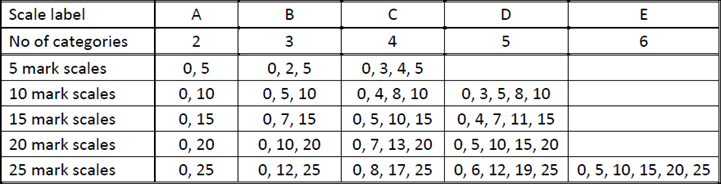
Sample Marking Scheme Scale for Leaving Cert Maths
This is an example of how the paper is marked and shows the opportunities to pick up marks depending on how many marks are allocated to each question.
LC Maths Exam Paper Layout – Paper 1 and 2
In 2026, we have Section A: 6 short questions of 30 marks (Do 5). In Section B, these are the more practical real-life scenario questions. There will be 4 long questions in Section B (Do 3) (50 marks each). [Both Higher and Ordinary level]
Even though there is a choice on both papers, I would NOT attempt an extra question in either Section A or Section B
My proposed Timing for 2026: (Apply the 15:25 rule for LC Exams 2026)
5 minutes to choose your best two short questions. You will make up this later.
Short Question (Complete 5) (30 marks) – Max of 15 minutes each.
Long Questions (Complete 3) (50 marks) – Max of 25 minutes each.
Set out a time budget plan before your exam and stick to it.
How do attempt marks (Low Partial Credit) work in Maths?
You can pick up 2/5 and 4 or 5 out of 10 for just getting one step in the right direction. This is called Low Partial Credit:
Writing down the correct formula and subbing a relevant value into it [‘Relevant substitution’]
This could just be writing down line one
Bringing down the last answer and doing something sensible with it
Also...
Write down everything – a formula from your Log tables, a step, a piece of English, a diagram, a table anything at all. If you type something into your Calculator, write it down. The examiner will be desperate to give you 2/5 or 3/10 or 6/20 or whatever Low partial credit is for each part. They will take no pleasure at all in giving you zero.
You may use a different way to solve a question (with success) that’s not written on the examiner's marking scheme - this is full marks.
If you make more than one attempt on a question, make sure to leave both visible on the paper. Never scribble out anything. Never write a ‘?’ on your paper.
Draw a single line through a method you feel is incorrect, it will be checked and may be allocated marks
What if I need an answer from the previous part to answer the next part?
There are two possible scenarios’ here. If you got an answer you think may be wrong and need to use it further down the question, carry it down anyway. If you didn’t get an answer at all and need one further down, explain in a note to the examiner that you are going to guess the answer needed and use it. You might word it something like:
“I didn’t get a value for x in part a so I’m going to assume that x=10 here.” Write this down and continue on…You can still get high marks for this question
What do you do if you mind goes blank?
Fill in something you have done in class related to the question being asked.
Use all the Information given in the question in some way.
Use a formula you think may be relevant to the question.
Any correct element to a question will give you low partial credit
What are the core skills I cannot live without for LC Higher Maths?
Solving a linear and quadratic equation
Solve a simultaneous equation (Basic JC Method or by substitution)
Subbing into a formula
Being familiar with Log Table Formulas (See below)
Why are Log Tables so important?
Each student will have a set of log tables on their desk when they go into the exam hall. You will not be allowed to bring in your own set of log tables. Know what’s in your log tables but more importantly what’s not in your log tables. Be familiar with roughly where each formula is in the tables so you are not in a mild tizzy trying to find one.
Learn the formulas not in your Log tables. Enter these into a hardback notebook now and start memorising them. Guidance and advice for Maths Paper 2 will follow very soon. Stay tuned to Joe’s Jotter Blog for updates. Joe
We at ACE Maths Tuition are now enrolling for 3rd, 5th and 6th Year Classes for September 2026. For more, press on the link below. Please note that places are filling up quickly and that every student may not be offered a place: